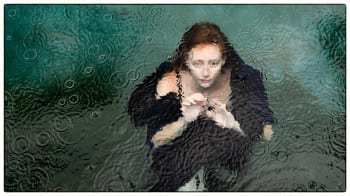
Hall was the Juror’s Award Winner for our exhibition “Open.” The Juror was Dan Burkholder.
How did you come to photography?
The first thing that really sparked my interest was Life magazine in the 60’s. I would come home from school, get a king sized bottle coke, and kick back in the naugahyde lounger and devour the latest issue. I also really enjoyed looking at old family albums being particularly drawn to how sharp some of them were compared to others. I started working as a photographer in 1979 and would like to say “it’s been downhill ever since”, but I won’t, ’cause it wasn’t.
Can you tell us about your images?
I noticed one day that an awful lot of my favorite images I have taken over my lifetime involved water in some form or fashion. My water portraits are a more direct approach to that realization.
Hall, as a professional photographer could you chime in on the analog/digital debate?
When I started out I went out and took a picture with a 35mm camera usually with film never exceeding 400ASA. I then went into the darkroom and “made” a photograph. I got what I wanted as much by happy accident as by a scientific approach to the exposure/development correlation. This changed over time to a certain degree. While I personally considered my skills in the darkroom to exceed or at least be equal to anyone I always found that when making a print that involved a lot of manipulation it was difficult to make more than one exactly the same.
Now, as a commercial photographer, I shoot exclusively in the digital format. While I still hold on to my old 4×5 and have film in the freezer waiting for the affordable return of polaroid, I find that modern technology far exceeds the capability of 35mm Plus X film. Now I go out and take a picture with a DSLR and then I go back to the computer and “make” a photograph. Sometimes it’s what came straight from what I shot. Other times I “burn and dodge” in the same ways I did in the darkroom. The magic being in that once I get it like I want it I can reproduce it exactly forever. The other thing about the new technology is that many modern cameras are now able to capture things in light so low we can barely see it ourselves. How cool is that?
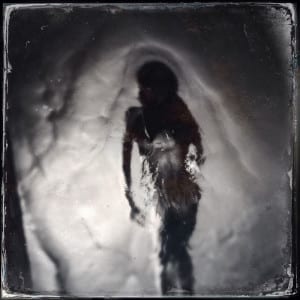
Steve was the Juror’s Award Winner for our exhibition “abstractions.” Eddie Soloway was the Juror.
How did you come to photography?
I am formally trained as a graphic designer and was employed in the advertising industry for 20 years. I began my involvement with digital photography in 1991, while shooting product photography for a variety of clients. Although my roots were commercial in nature, I now use the camera as an artistic tool. Photography is my creative outlet. It is my way of expressing myself to the world. I’ve tried other artistic mediums (painting, drawing, etc.) but found the process of using those materials too slow and tedious. The camera allows me to simplify the artistic process and be more productive.
Can you tell us about your images?
Aqua Nocturna is a project created entirely with an iPhone and Hipstamatic app. Therapeutic in nature, this series began the night I buried my father. After the funeral, the family gathered at my sister’s house. Many of us turned to the backyard pool to relax and unwind from an emotional day. Water is the source of life. It has the power to sustain, comfort and heal. These ghostlike figures represent the spirit. Although the body may perish, I believe the spirit continues within the next generation. My goal was to capture that spirit, and bear witness to the healing power of water.
Because of your graphic design background do you see the making of a photograph as a design problem?
I hadn’t really thought of it that way, but now that you mention it, I guess so. There are parallels between the two, solving the “problem” of composition being paramount. However since I approach photography as a fine art (vs. commercial design), the challenge doesn’t come from a client, the challenge comes from within me. In many ways, this makes the problem more difficult to solve. I oftentimes don’t understand what I’m trying to say at first. But the longer I work on a project, the easier it is for me to see “the big picture” I’m trying to get at.
Hi there, this is Kevin, the other Gallery Director here at A Smith Gallery. I was given the task of keeping the blog portion of the website going about a year ago. However, because of us having to move and other things out of my control (sounds pretty good to me — Amanda isn’t buying it either) I am just now getting around to it. I promise to do better.
This is going to be the first of my catch-up posts. I apologize to Mark and all the other recent Juror’s Award Winners for my tardiness. The following are the three questions we ask our winners.
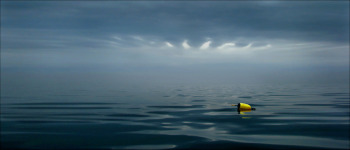
Mark Hopkins was the co-winner along with Carol Erb of the Juror’s Award for our exhibition “water” juried by S Gayle Stevens. Mark’s image was especially compelling to me because I grew up fishing on the Texas Gulf Coast. He captured that moment of absolute serenity on certain calm fishing days of my childhood, when the cork would slowly drift, waiting, and along with the gentle movement of the boat, could induce an almost hypnotic languor. A pretty remarkable circumstance for a kid with ADD.
Mark how did you come to photography?
I bought a digital camera in 2004 at age 72 and got fascinated with the control that it and PhotoShop afforded. Before that, cameras were just things to take along on trips. Trying to do good stuff has been my freetime goal ever since.
Can you tell us about your images?
My primary aim is to capture closeups of forms in nature. This has covered everything from rock formations to vegetation to water reflections to window frost.
Mark, could you tell us a little bit about your life before camera and how life with camera has affected or influenced your view of the world or how you look at it?
Life before ‘camera’ involved mostly reveling at the enticing visual aspects of everyday life and not wanting to have a camera between me and those images. Life after ‘camera’ has delivered the satisfaction of being able to share that fascination with others.
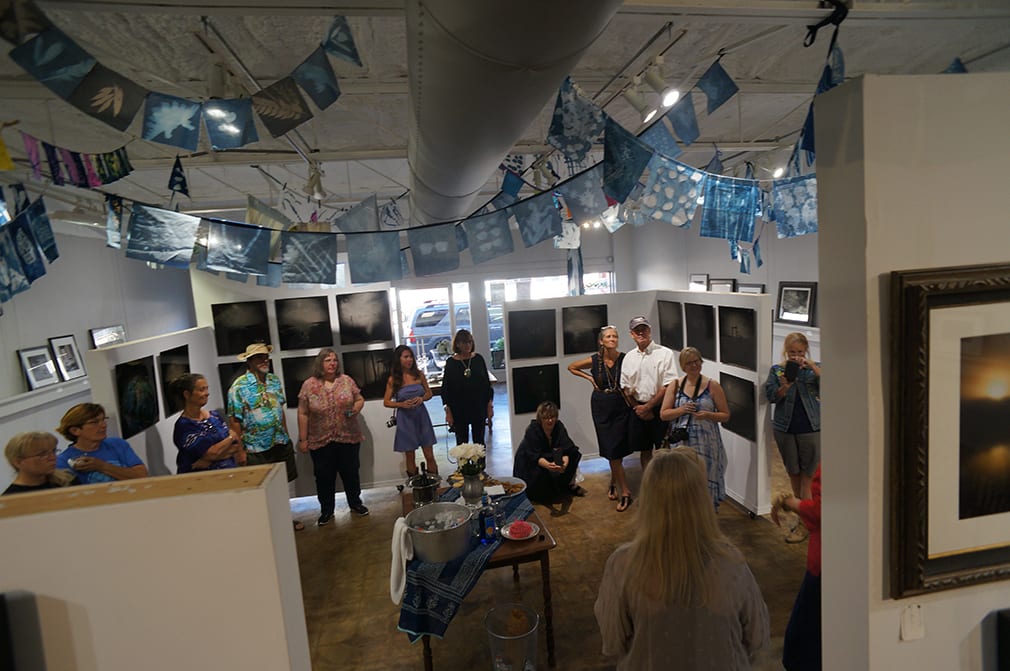
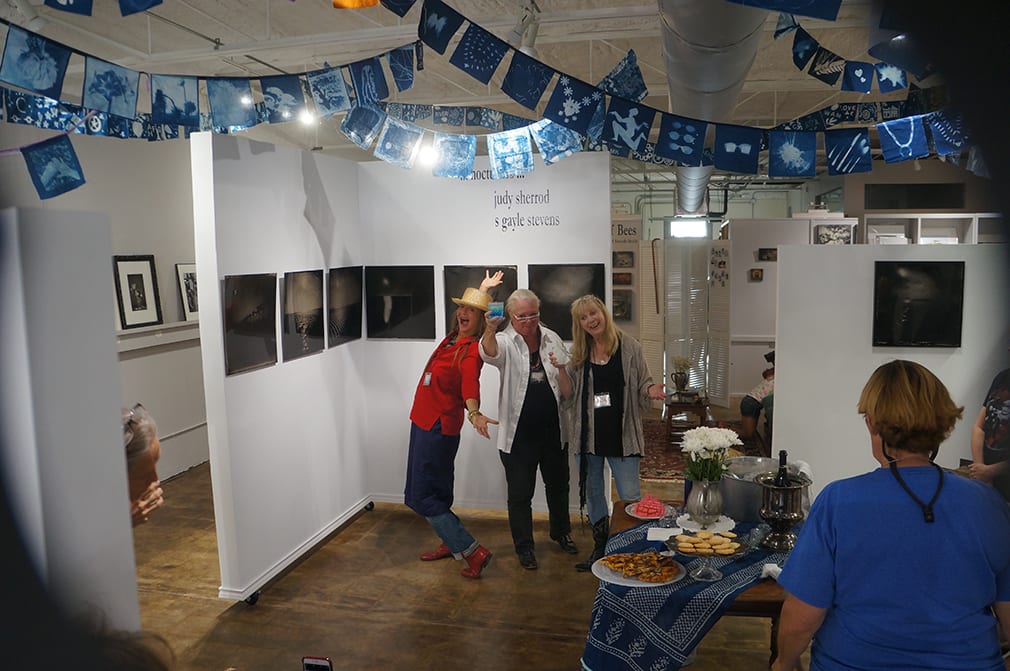
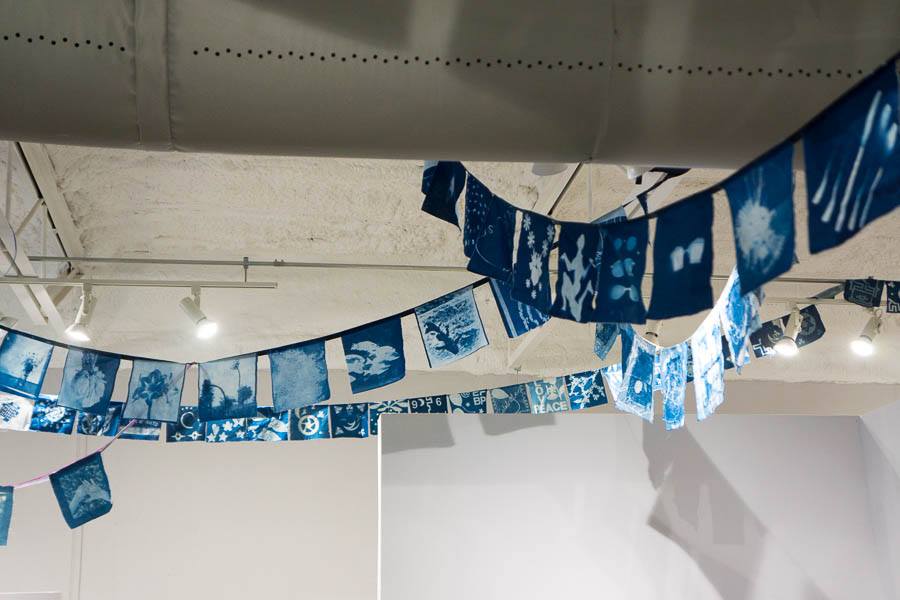
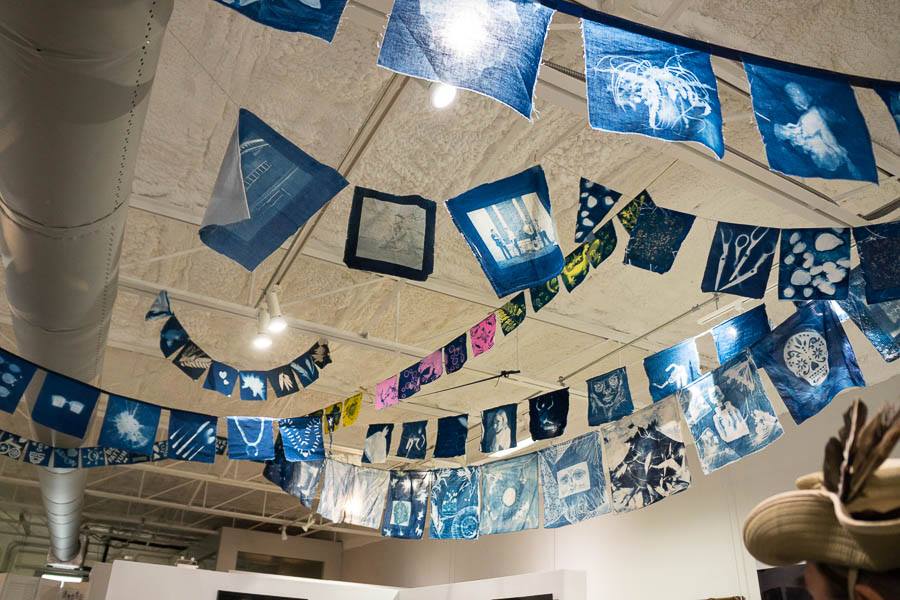
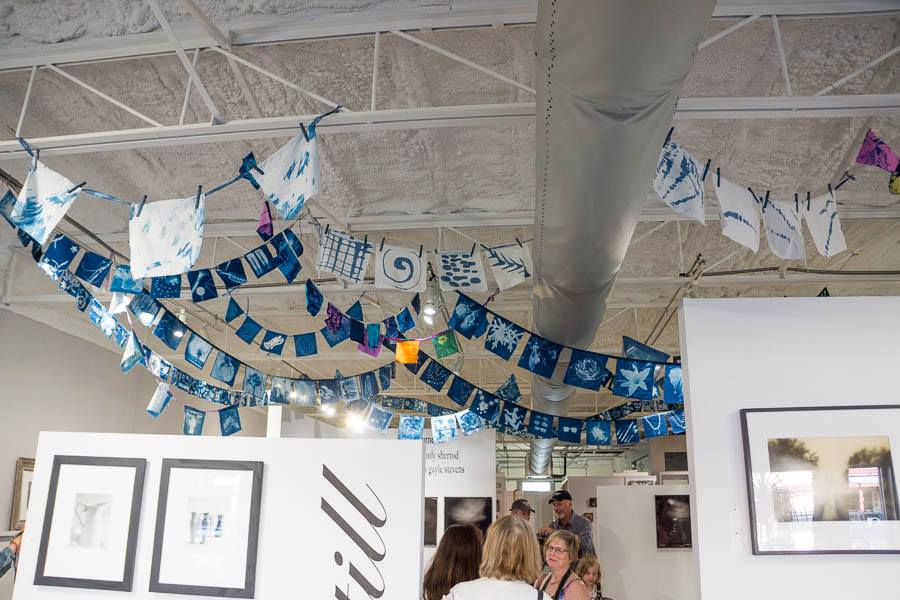
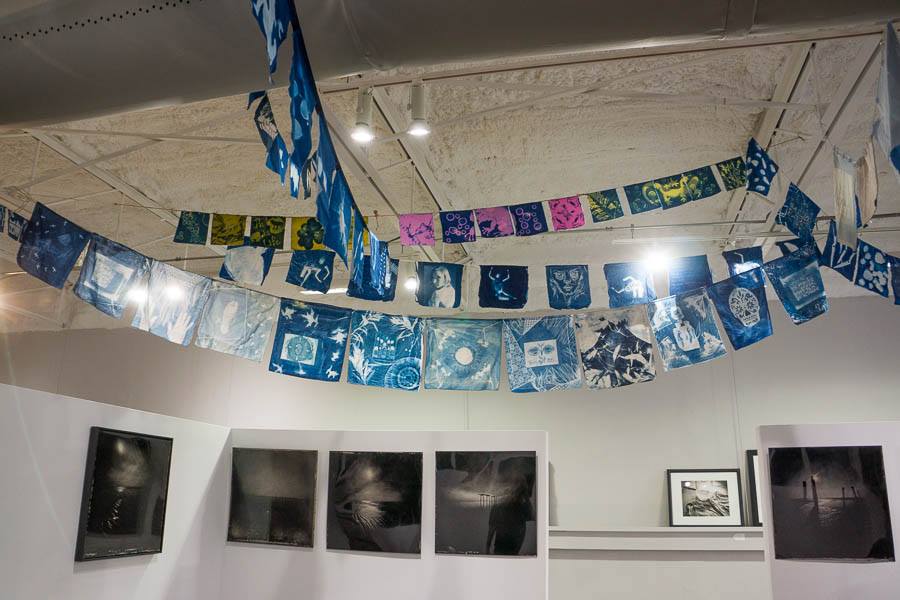
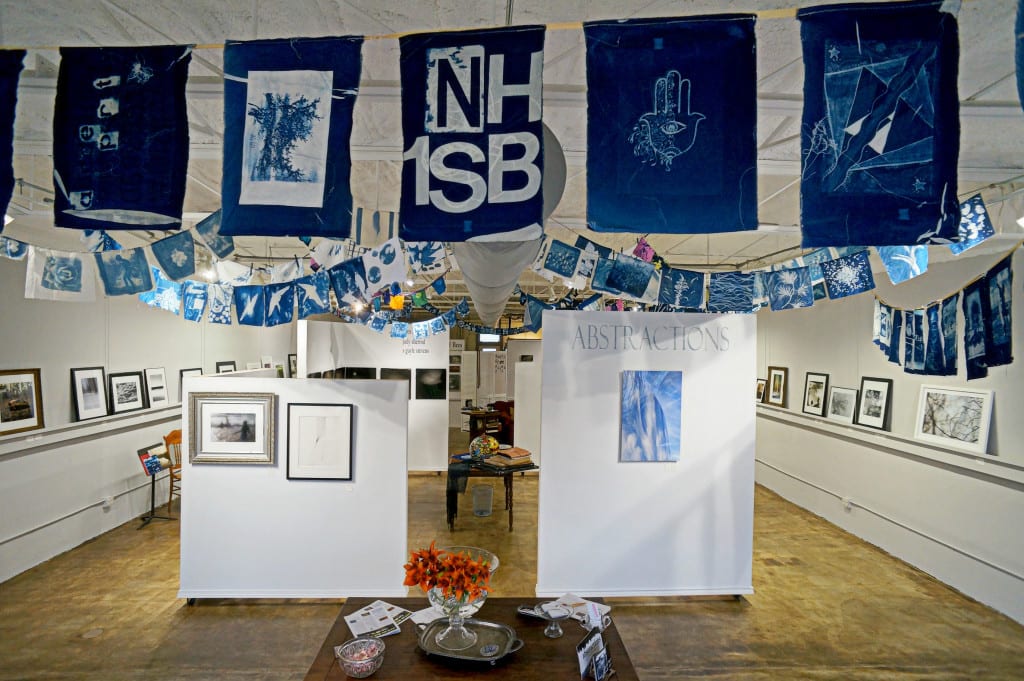
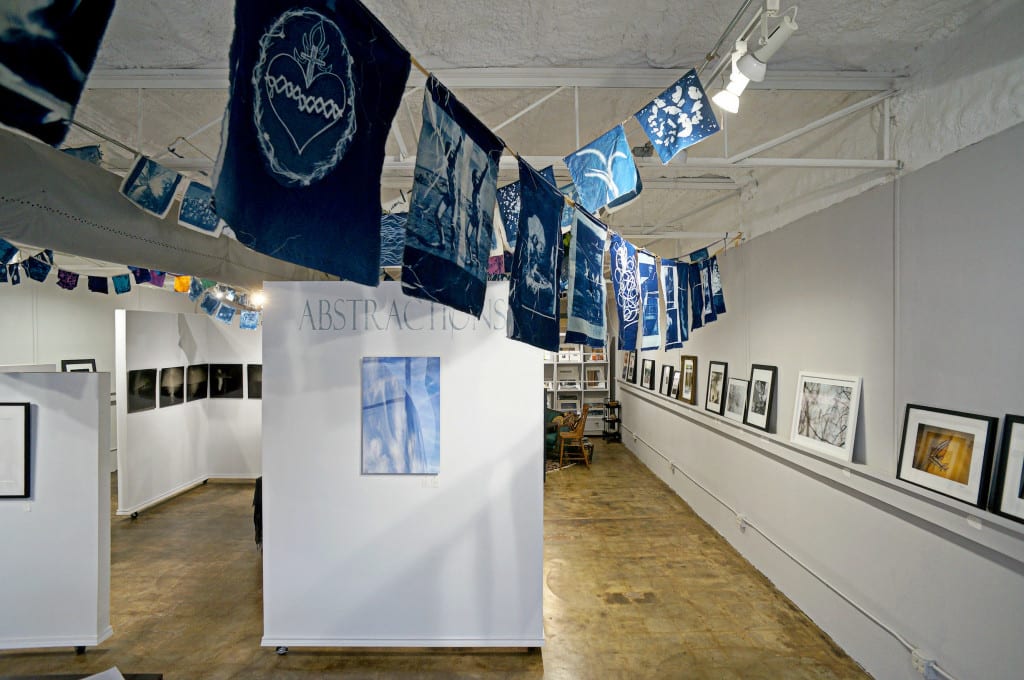
The Tibetan tradition of hanging prayer flags began more than two thousand years ago. The prayers, invocations and mantras imprinted on them were thought to carry on the winds, to the surroundings and all that passed under them, happiness, peace, wisdom, strength, long life and compassion. In commemoration of World Cyanotype Day, founded by Judy Sherrod, we, with Judy’s help, sent out the call for cyanotype prayer flags to hang in the gallery for the celebration. The response was tremendous. We received flags from all around the country and the UK. It truly was a blessing to have the incredibly creative and evocative cyanotype creations hanging in our new space. We want to thank all the artists that have given our new home this blessed beginning. Thank you: Shari Rhode Trennert, Mariana Bartolomeo, Barbara Murray, Vicky Stromee, Margo Barnes, Paula Riff, Sandra Klein. Pat Brown, Amy Jasek, Michelle Lewis-Smith, Ann George, Heather Pyles, Kimberly Chiaris, Aubrey Guthrie, Donna Moore, S Gayle Stevens, Jackie Stoken, Johnny Powers, Valerie Burke, Mel Levin, Ky Lewis and the students of Niall Hunter at South Hampstead High School in London, England.
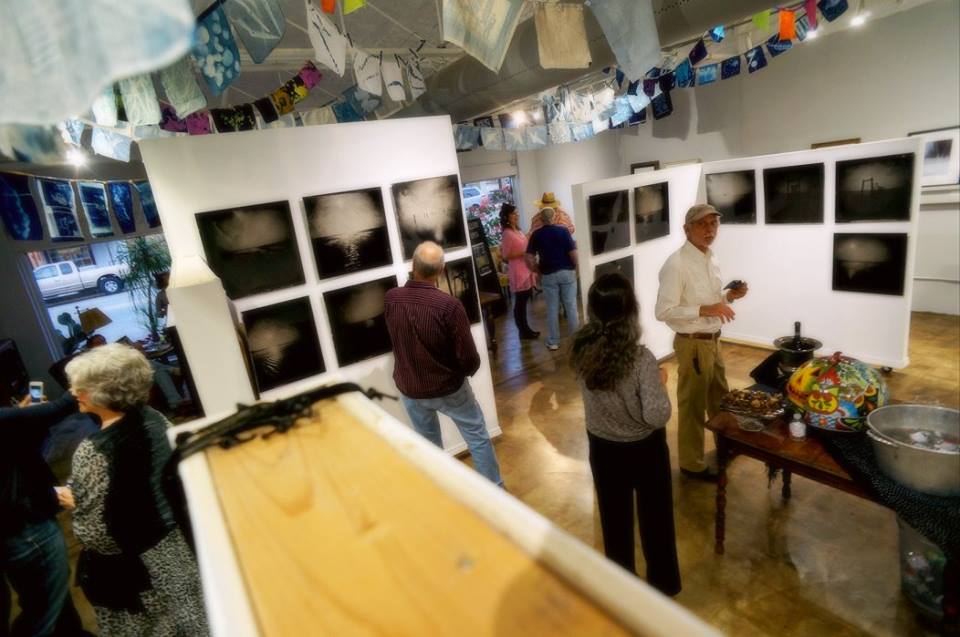
The first reception at A Smith Gallery in our new space was Saturday evening, July 25, 2015. It was a fantastic evening, thanks to everyone for sending us the good energy. Thanks to Al and Kay Pratt of Lady Bird Lane Cafe for gifting us the wonderful victuals. Thanks to, the ever-friend, the indefatigable Aubrey Guthrie II for helping us get up and running. Thanks to Sandra Klein for the surprise champagne. Thanks to Steve Goff and Beckwith Thompson for sending energized young photographers out into the world. Life is good. We are honored and humbled by all the talented and generous artists out there allowing us to march in this parade with you.
Ray Collins is a miner and an amazing photographer of the oceans topography. Arthur Meyerson, juror of our recent exhibition “blue”, gave Ray his Juror’s Award for three of his seascapes. Ray has won many awards and accolades and was recently a short listed finalist for the prestigious Smithsonian Annual Photo Contest. It is hard to peruse social media these days without coming across Ray’s work. The following are three questions Kevin posed to Ray concerning his images.
Ray you certainly have made a splash in the photography world recently. Forgive the pun. Your images are being admired and debated all over social media and elsewhere. The four we had up in the last exhibition, “water,” were some of the most discussed we have ever hung. Could you please give us a little background and some insight into your process?
Basically, the image you see is the final link in a chain of events…
I spend hours, days or even weeks and months pouring over weather maps, checking storms, tides, wind, swell, temperature and light. From there I correlate all the information and see where along the coastline my best chances of dynamic waves will be. Most places aren’t user friendly and can often require scaling down cliffs along some treacherous coastlines to reach offshore reefs, usually in the dark so I can make the most of the golden morning light.
Having a heavy pro body camera inside a water housing with a prime telephoto lens can get very heavy at times and as the ocean is pulling and pushing you into and under the waves you have to then focus, compose, adjust shutterspeed, aperture and iso all while staying a float and out of danger, it can often all come unstuck…
But you have seen the end result.
And as long as I draw breath I will continue to push my own boundaries of image making.
Ray, I understand that you used to be a coal miner. Your photographs capture light emanating through and reflecting on water, transforming a wave into a prismatic solid on paper — a fixed phenomenon; no longer transitory or fleeting. Did your time underground in a world void of natural light inform or influence your photography?
Still am a coal miner in fact! I want to freeze the ephemeral. I want to show my relationship with the ocean as it is all I have ever known. I feel an intimacy when I am immersed and I want to show that. I’m not sure there is a direct parallel between coalmining and ocean photography, but in saying that… The photos have me woven through them, my interpretation, myself, and I’ve been working 12hr shifts underground for 12 years now so that has influenced me as a human and most probably transferred into the images I make. It would be cool to see a parallel universe of what my images would look like if I never worked in the mines, how different they might be. But tearing my knee at work underground in 2007 is what led me to buying my first camera so it’s an impossibility.
I know that you are a surfer, as someone that briefly dabbled at surfing as a young man, the two things that I took away from attempting to ride waves was the understanding of the raw power of moving water and the undeniable rhythm and cadence of breaking surf. Your photographs render the ocean beautifully static and solid. Is there something of rock here or am I overanalyzing?
That’s the beauty of art isn’t it, the interpretation that we each bring to an image. The way it makes us feel and the way it makes us draw from ourselves, our experiences and our understanding of life.
Kim Turner Smith is very patient, and this is the very least of her talents. We have been so busy and it has taken too long to get her to the blog. Thanks for your understanding Kim. Kim was the Juror’s award recipient for our call for entry “Treasure.” Roy Fulkinger was the juror. We asked Kim a few questions.
How did you come to photography?
As far back as I can remember I have been fascinated with photos. I used to love looking through my grandmother’s old family albums and hearing the stories of the people in the pictures. In middle school I had a 110 camera that I carried around taking goofy snapshots of my friends and family. My mom would get so frustrated when we would go pick up the film from the photo lab. She would grimace and say “this one is a reject”or “this person isn’t even looking at the camera”. During high school I got my first ‘real’ camera and took a photography class and learned to develop my own film and make silver gelatin prints. This is when my passion for photography really intensified. I continued studying art and art history into my college years graduating from Columbia College Chicago with a concentration in photography. My time in Chicago were some of the most impactful years growing and evolving as a person and an artist. It was an amazing time that I’m so grateful for.
Can you tell us about your images?
The two images in the Treasure show are from my series titled Childhood which documents day-to-day moments in the lives of my children. I push myself to look beyond the steady routine and mundane demands of daily life and find the magic in those fleeting moments. As I listen to my girls engage in fantasy and play, their perceptions of the world are revealed. I am drawn to capturing the momentary tableaus that have a sense of mystery or oddity. I hope the photos reflect the essence of play, spontaneity and wonder but still retain the authenticity of our daily life. Whilethis series is ultimately a tribute to my own children I’ve discovered that it’s also a documentation of my journey as a mother. As I watch their little bodies and listen to their inquisitive minds, I am reminded that parents are privileged to experience these moments. This time will someday feel ephemeral; these are the days that I will one day want to relive.
Does a sense of place play a part in your photography?
A sense of place plays a big role in my photography, but so does lack of place. Not necessarily geographically, but psychologically. Themes of family and home are common threads in much of my work, but I am also attracted to concepts of humans lost in their environment; the superficial and artificial, and breaking my everyday surroundings down to banal components out of context. This is what I’m exploring in both seriesNavigating Circumstance and Neighborhood.
Could you tell us more about what you are currently working on?
Lately I’ve been experimenting rather than working on a specific project. I’m mostly shooting film with the intention of “messing it up”, light leaks, blur, cross-processed, over exposed. The imperfections and surprises are what I love most about shooting film. I also recently took an encaustic workshop and am enjoying the process of creating tangible photographic objects again. I’ve been missing the craftsmanship of making darkroom prints and have always been intrigued with encaustic, so I’m excited to experiment with this. Not sure where my work is going at the moment and I’m enjoying not having a plan.
If you were a camera what would you be?
Definitely a film camera with expired film. Probably a converted Polaroid 110a camera with type 59 film.
A couple of weekends ago, we hosted a tremendously fun and energized reception for the “treasure” exhibition. The evening was enlivened by Richard Orton signing his book,”The Upshaws of County Line, An American Family” and the gallery talk given by Roy Flukinger, the juror of “treasure” and the writer of the preface to Richard’s book. We also had all the great folks that attended Meri Walker’s “It’s Not Just Luck” iPhone artistry class, sponsored by the gallery, that was held just down the street.
The weekend started on friday evening with a casual pozole party in the gallery. For those that aren’t familiar with pozole, it is a traditional mexican soup or stew. The basic ingredients are pork (or chicken or tofu), hominy and five different kinds of dried chilis. Pozole is hominy in Spanish. It is a great communal supper because of the accoutrements and condiments that go along with it: cabbage, queso fresco, avocado, tomato, onion, fresh chili pepper, lime, mexican oregano, tostadas and more. Set all this out on a table and hand someone a steaming bowl of the soup and watch ‘em break out in a big grin! There was a bunch of grinning going on the other night which was most definitely helped along by the tasty margaritas made by Judy Sherrod, of Shootapalooza fame, and the great conversation. This is what it’s all about.
Meri Walker’s iphone workshop continued on Saturday morning down the street at Chantilly Lace Bed and Breakfast. Porter and Sylvia’s southern hospitality and great meals are legendary around here. Porter can be abrupt sometimes. Some say it’s because he hit his head in a plane crash years ago. Others say it’s because he’s always hungry. Sylvia knows, but she’s not talkin’. We owe Porter and Sylvia a big “thanks guys” for helping us make our workshops an ongoing success.
From all the very interesting posting going back and forth on Facebook by the class participants it appears that Meri’s class was a great adbenture. We have especially enjoyed watching our friend, Aubrey Guthrie, burst out into social media — keep on truckin’ Aubrey!
The reception Saturday night was one of the best we’ve had. We had folks from all across Texas. We were especially pleased to meet the photographer Remi Lai. He came all the way from Kirksville, Missouri. The evening ended with another great communal meal at our local brewpub, Pecan Street Brewing. Thanks to all who came and made the weekend a memorable one.
Oh, check-out the very amateurish video of the exhibit below. We will get better at this. Amanda apologizes for slaughtering the photographers names. We will also get better at this.
See ya!
Aubrey Guthrie
Shootapozole
Nate Forman and friends
Hi Izzie!
Richard Orton signing his book for Ashton Thornhill